“Today’s AI early adopters will lead tomorrow’s markets, making AI training mission-critical for future-proofing organizations. As AI adoption continues to grow, comprehensive AI training will be essential to stay competitive and innovative.”
According to the recent report by Slack, 15% of workers agree they need training and education to use AI effectively. This need for training has been a long time coming, given how fast we’re advancing. It’s challenging to keep up, not just for employees but even for leaders.
In order to understand this challenge better, we talked to an expert, Hamsa Suresh, to help our HR community stay ahead of the curve.
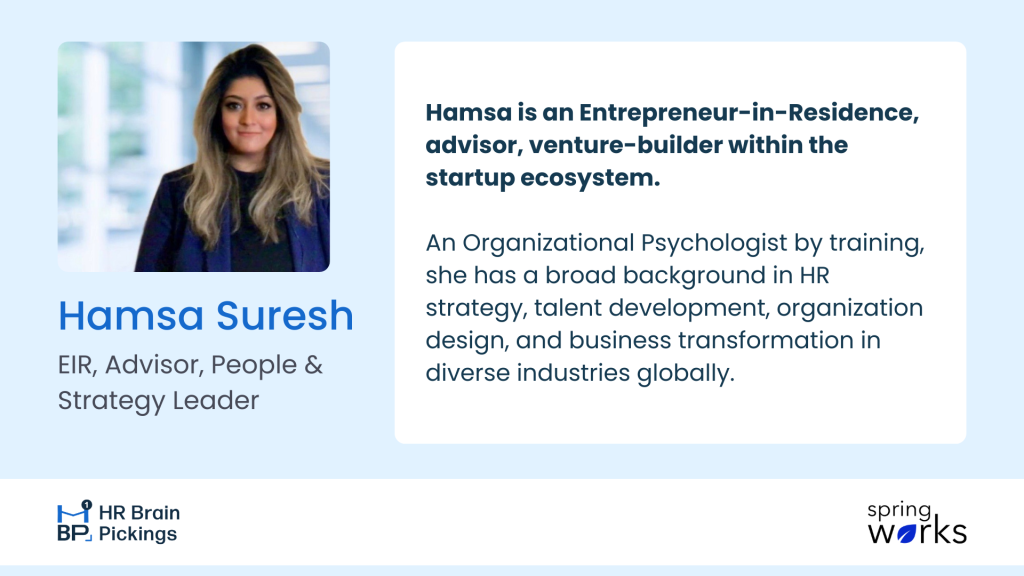
Hamsa: Let me start by saying this – every company is now a tech company. Whether you’re in manufacturing, retail, consumer business, or e-commerce, cloud point of sale, you leverage technology in some way, either to serve your customers or to optimize internal operations.
AI brings efficiency and productivity gains by automating repetitive tasks, allowing employees to focus on strategic and creative work. Given that AI adoption will only continue to grow, upskilling your workforce in AI is an investment in future-proofing organizations. From an employer’s perspective, it’s essential to ensure the workforce is ready to leverage new technologies to be able to quickly adapt to industry changes and market demands
Also – I prefer the term “learning” over “training” because learning is more self-directed, intrinsically-motivated, human-centered and empowering, giving employees agency to upskill and reskill. Employers who foster a learning culture benefit in terms of talent retention, decision-making, and overall competitive advantage.
Hamsa: AI is crucial for organizations of all sizes. Startups, in particular, can benefit from AI to level the playing field against larger competitors by automating tasks and optimizing resources. Larger organizations will continue to incorporate AI across various functions to maintain their edge and drive large-scale innovation.
The beauty of AI is its scalability. AI tools can be tailored to the size of the organization and the number of end users, making it versatile and accessible for everyone.
Hamsa: The details will definitely be contextual to your company, but at a high level, there are foundational topics that I’d recommend covering regardless of nuances in business context:
By addressing these areas, you can ensure your employees are well-equipped to start leveraging AI effectively and ethically.
Hamsa: That’s definitely an emerging area, and it’s very gray, especially when dealing with sensitive information. It depends on your AI maturity as an organization. Not many companies are optimized in AI to the extent that they need to worry about teams misusing it. However, it’s important to consider what the guardrails for AI usage should be. For what purposes do we use it? For what purposes do we not use it?
This is similar to managing a community where you always have guidelines to prevent chaos. Just as you set a culture and align on values and team norms, you should set structure and guardrails for AI use within your team.
Bias and data privacy are strong considerations, especially in HR. Many external discussions are happening around regulation. Employee privacy and preventing information leaks are paramount– and compliance with regulations like HIPAA can potentially be violated if AI-powered HR tech tools aren’t properly vetted and used by HR teams. HR is a dicey area that is ripe for needing an AI usage policy.
Outside of HR, where people don’t have access to employee data, compliance and norms are still required (to comply with GDPR laws and such) but with less immediate risk of lawsuits. When guiding AI implementation and usage (within HR), I recommend HR leaders use the “Minimum Necessary Rule” – ask yourself: what’s the least amount of data we need to use in our AI tools – to stay compliant and ethical?
At the minimum, having an understanding of whether we are using AI responsibly and for the right purposes is a good start.
Hamsa: The most impactful AI implementations I’ve seen are in manufacturing. In one of my previous roles, I led a digital transformation project for a labor-intensive production site making the leap to a smart factory.
The integration of robots and new technologies rendered many roles redundant, necessitating reskilling the traditional, manual Operator tasks into roles that required higher-level, creative tasks such as troubleshooting, problem-solving, maintenance, performing machine changeovers, resetting robots, and interpreting data.
To support this reskilling without pulling workers off the shop floor for extended periods, we brought the training directly to them. We installed industrial kiosks and iPads in accessible locations near the machines. These devices provided on-demand micro-learning videos, and resources linked to our internal learning experience platform, enabling real-time problem-solving and performance support on the shop floor – easily accessible anytime, in real time, each time they faced a troubleshooting problem (which, in manufacturing, happens a lot).Additionally, we invested in augmented reality (AR) headsets connected to the iPads, which provided immersive simulations and visualizations/visual guidance overlaid on the machines.
This setup facilitated microlearning in real-time, directly in the flow of work, and in front of the equipment. This approach not only saved time but also reduced costs, increased production efficiency, and accelerated time to market.
Hamsa: Good old-fashioned change management is crucial, but it needs to be done right.
Hamsa: I’m not sure if you are going to like this response but I’m not a big proponent of having an obsession over a tech-first mentality. There is plenty of cool tech, LXPs and AI x HR platforms out there, but I always start with the “why” and the process. If you are not sure where to start with implementing AI training for your employees, here are a couple of pointers to help you navigate through:
| What do Do | What to Avoid |
| Have a clear understanding of the specific issues or goals you aim to address within the context of AI training and its relation to your broader business context. | Avoid integrating tools just because they are currently popular in the market. |
| Assess your existing culture, talent philosophy, values, and work processes. Ensure the tool or service you choose augments and streamlines these processes. | Implementing tools that are incompatible with how your team operates will not only end up as a suboptimal resource but also diminish your team’s effectiveness |
| Advocate for live, hands-on learning experiences like workshops, creative sprints, hackathons, or internal Shark Tank events. Focus on creating learning experiences that nurture true learning, performance, and behavioral change. | Avoid run-off-the-mill L&D approaches through LMS or LXP tools that result in passive information consumption (online courses, etc). This method is rarely effective and often fails to engage employees. |
| Create structures, frameworks, and guardrails for learning experiences. Ensure these activities are embedded into the overall learning strategy. | Don’t micromanage the learning process. Create the right conditions and then step back and allow employees to take the lead. |
| Focus on metrics that reflect real learning outcomes and business impact. Measure the impact of training on job performance and tangible business results (ROI, revenue growth, cost savings, customer NPS, Employee turnover & retention, etc) | Avoid relying on superficial metrics like time/hours spent learning, completion rates, etc., to gauge learning effectiveness. These alone do not indicate effective learning. |
| Secure leadership support for the success of any new AI learning initiative, as it demonstrates the organization’s commitment and provides the necessary support for implementation. | Without endorsement from the top, the AI initiative (and learning efforts) may be seen as low-priority, not be given adequate resources, and ultimately will not gain traction successfully. |
HR’s role is to create the right conditions and then step back to let employees shine. I don’t recommend courses where employees passively consume information disconnected from their business, just to earn a learning badge. Completion rates are the wrong metric and often miss the mark in achieving real learning outcomes.
Hamsa: I would advise moving away from surface-level metrics and KPIs such as completion rates, hours spent learning, and participation trophies. These can exist in a vacuum and be disconnected from the business, often leading to L&D being the first area cut during layoffs due to perceived lack of ROI. While they may be useful for reporting to the board, they do not show how learning initiatives are moving the needle for your business.
For AI training, one useful metric is the adoption and utilization rate of a particular tool or technology. This measures how quickly and efficiently employees are navigating and leveraging the tech in their day-to-day workflow.
Overall, the most impactful metrics and KPIs are productivity-oriented and tied to organizational performance. These could include ROI, revenue growth, cost savings, new product development, customer net promoter scores, and employee turnover and retention rates.
Hamsa: The future of AI training and HR tech is very exciting. AI tools and HR experience platforms are becoming more sophisticated and nuanced, offering personalized, data-driven solutions for both employers and employees. This evolution is crucial because traditional L&D methods are often time-consuming and ineffective for mass reskilling to meet business goals.
The future is hyper-personalization. It’s an exciting time for HR and L&D!
Pushing AI training or rolling out co-pilots without understanding what exactly you’re trying to solve for can lead to resistance and inefficiencies.
Hamsa: For leaders, my advice is to think about why you are implementing AI and what your business goals are. Start from a process-first approach. HR and L&D should encourage leadership and employees to examine current operations and workflows to identify areas where AI can bring efficiencies.
Pay attention to this process because pushing AI training or rolling out pilots without understanding the exact pain point you’re solving for can lead to resistance and inefficiencies – and you’ll be automating waste (non-value added activities within a workflow). Always start with the process and then select the technology.
Leaders should also study what has made AI implementations succeed or fail. Look at use cases and build strong relationships with your IT team. Start small with pilots and let the change be evolutionary, not revolutionary. Focus on what will make step changes for your business and cut through the external noise and hype.
At a broad level, use tech to bring out the genius in each team member, nurturing their creativity and innovation. The quality of your employee experience drives the quality of your customer experience. AI is a means to an end, not an end in and of itself. At the end of the day, the KPIs that will always matter are: do your customers love your products? Are you truly serving your clients? Do they align with your values? Have you elevated the human condition through your culture, employee experience and the responsible use of AI?