
As we move towards a more dynamic market environment, organizations across all the industries need to work on re-defining and re-imagining their new hire onboarding process to survive in this competitive market.
Why is an onboarding checklist important? It is the first peek a new hire gets inside the organization’s culture. Our approach toward the new employee onboarding process helps set expectations for the new hires on the first day itself. So, its very import that you build a checklist for new employees template to not only increase efficiency but also to not miss out on important stuff
Creating a smooth onboarding process will help the new hires understand the company environment and help the organisation achieve employee satisfaction.
In simple words, the process of efficiently introducing new hires to the company is known as Onboarding. It can be very organization-specific as different companies might have different needs and business functions. But even after being a little different in the larger picture, some basic steps of the onboarding plan for new hires that build up the process remain the same.
In this article, we will talk about how we can use these basic steps to build up an efficient employee onboarding process flow and give us the effective results that we desire.
First, let’s talk about the Importance of the employee onboarding process:
Research by the Brandon Hall Group shows that a good onboarding process can improve employee retention by around 82%. Along with this, here are a few more benefits of an efficient onboarding process:
Your onboarding process is a new hire’s first impression of the company. You have to ensure that it effectively highlights the organisation’s values, systems, and culture. When your candidates undertake an efficient and well-planned onboarding process, it acts as a productive step towards a good employee experience. Moreover, you should take into account their predictive index results types to tailor the onboarding experience to their needs and make them feel welcome.
A good onboarding process and an enhanced employee engagement definitely call for better feedback towards the organization. If the process does not go as seamlessly as planned, a new hire can provide negative feedback, and their dissatisfaction can be portrayed in front of other potential hires as well.
A suitable onboarding procedure not only saves you from this threat but also improves the chances of employees referring new people to your organization.
An onboarding process is an amalgamation of buddy meets, team and manager meetings, etc. These meetings will help break the ice and make the new hires comfortable in the new surroundings.
As studies mention, 70 percent of those with exceptional onboarding experiences say they have “the best possible job.”
As mentioned earlier, your onboarding process gives insights into your organizational culture. When you work on improving the onboarding experience by all means- be it ice-breaking with the team, understanding the company functioning, or completing the necessary formalities- you showcase your attempts to provide them with an employee-centric environment.
Timeline of the events of new employee’s onboarding process
Let’s discuss all the above steps in the onboarding process:
Let’s go back to the day before our first joining day in a new organization, we all have faced the fact of being super anxious about what the first day is going to be like and also what is going to be expected of us. This step helps in cancelling out the nerves.
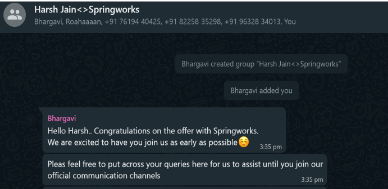

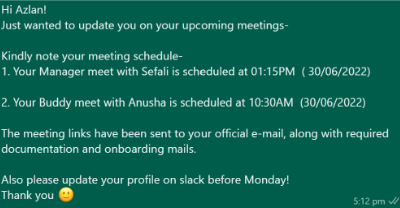

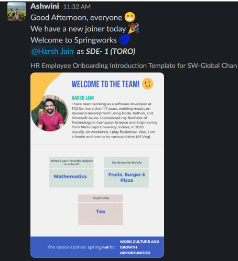
A new employee needs to have a clear understanding of what success looks like in the first 3 months and later of joining the company. They should understand how their job role contributes to the holistic growth of the organization.
This is crucial because understanding this will help them in performing better, thus making it easier to achieve targets and strategic organizational objectives.
A defined set of tasks and goals may be crucial in aiding a new employee in prioritizing and structuring work, as well as achieving some fast wins that provide the groundwork and momentum for the individual’s future success.
Over time, a job may change, adapt, and grow more intricate, but having clarity at the onset will provide a foundation from which the person may adapt more easily.
Smooth onboarding & offboarding are crucial for employee success and satisfaction. A shaky start affects the confidence of a new hire and makes the hiring decision questionable for the company. The best employee onboarding process is the one that never ends.
The onboarding program needs to be the blueprint for an individual development plan that tends to build a strong foundation of the employee’s cultural alignment and performance in their specific job role.
Don’t forget to check our employee onboarding guide here
Induction & Orientation– Introduction to the company and its key personnel, examination of the manual, significant policies, relevant compliance documents, and exploration of the company’s values are all part of orientation.
Training– Inform a new hire of their regular responsibilities and any other information they require to position them for long-term success.
Transitional support – Provide existing organizational members with the training they need to assist newly hired employees in understanding their roles and achieving maximum productivity.
Growth & Development– Create strategies for ongoing professional and personal development so that both the individual and the company may achieve their objectives and be successful.
In this article, you can find new employee onboarding best practices.
Compliance– In simple terms, compliance is getting all the paperwork in line along with fulfilling the legal requirements and rules of hiring a new employee.
Clarification– How effectively new employees understand their jobs and performance standards is referred to as clarification. This is a practice that is an integral part of the process as this helps in setting up expectations at the beginning of the employee’s life cycle in the organization, thus giving an idea about the level of performance required to achieve the listed expectations.
Confidence– This is the basic feeling of how capable a new hire feels to perform the job role assigned to him. Even if a company cannot directly improve the self-esteem of new hires, it can nonetheless create an onboarding process that will uplift employees rather than undermine them. Employees are more likely to feel good about their surroundings, their decision to work for your company, and themselves when they feel more confident.
Connection– Establishing an effective network of connections is another important aspect of effectively onboarding new hires. This helps in developing their willingness to assimilate into the culture of the organization.
Culture– The term “Culture” describes how well new employees comprehend the goals, objectives, and core principles of their new company.
Connection– For new employees, interpersonal connections are essential. Connection is, therefore the first element of a good onboarding campaign. The connection extends beyond simply introducing a new employee to their teammates. Connection develops a friendly and encouraging environment and offers the tools and resources an employee needs to feel at home in a new company.
Culture– A strong employee connection requires guiding new hires through the culture and assisting them in finding their place within it. Every entity has its own particular culture build-up. Introducing the employee to the company’s culture and gradually expecting them to accept it is a very important practice.
Communication– At every level of a company, poor communication can cause problems. Making new recruits feel at ease and secure in their new work requires having good communication with them as soon as possible. Each job’s expectations should be clear to employees. The onboarding experience for new employees is greatly influenced by training and support.
Onboarding new employees is important since it absorbs new employees into an organization. New recruits are given the information, training, and support they need to become effective members of the team.
Onboarding also aids in acclimating, engaging, and retaining staff. Acclimating personnel familiarizes them with the company’s requirements as well as its resources.
Once new recruits are familiar with the organization and their jobs, they might become involved. This is significant because engaged employees are more productive and are more likely to remain around since they care about performance objectives and want the firm to succeed.
In order for onboarding to be successful, both you and the employer should be learning during the process. It should also be well-planned, lively, individual, sociable, and meaningful.
Keeping it a one-way street might cause an information overload on the new hire that might affect the speed at which they feel comfortable in the organization.
Check out our employee onboarding checklist template to ensure that you are ready to welcome new hires, and prepare yourself with an onboarding checklist. Download it here